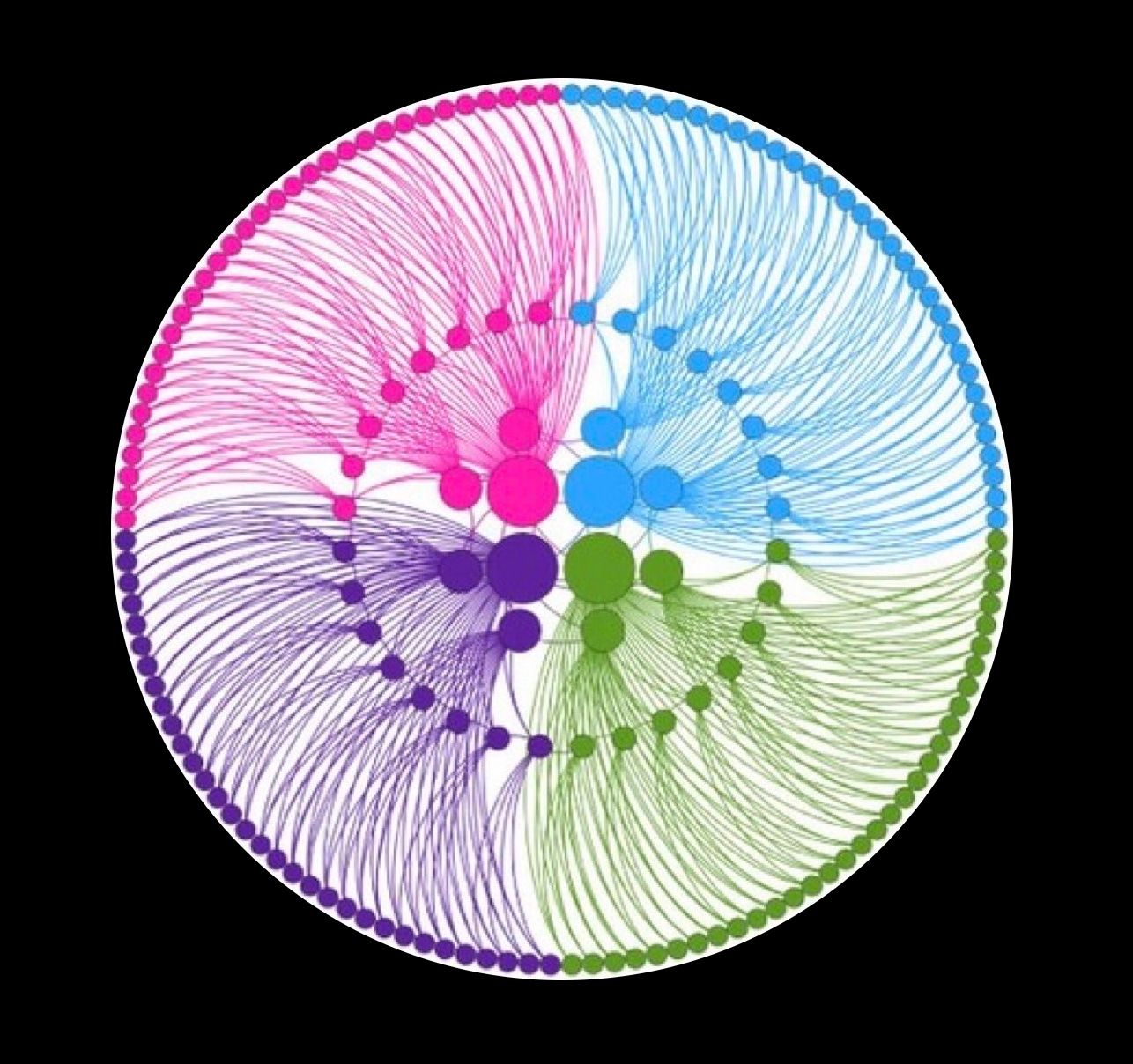
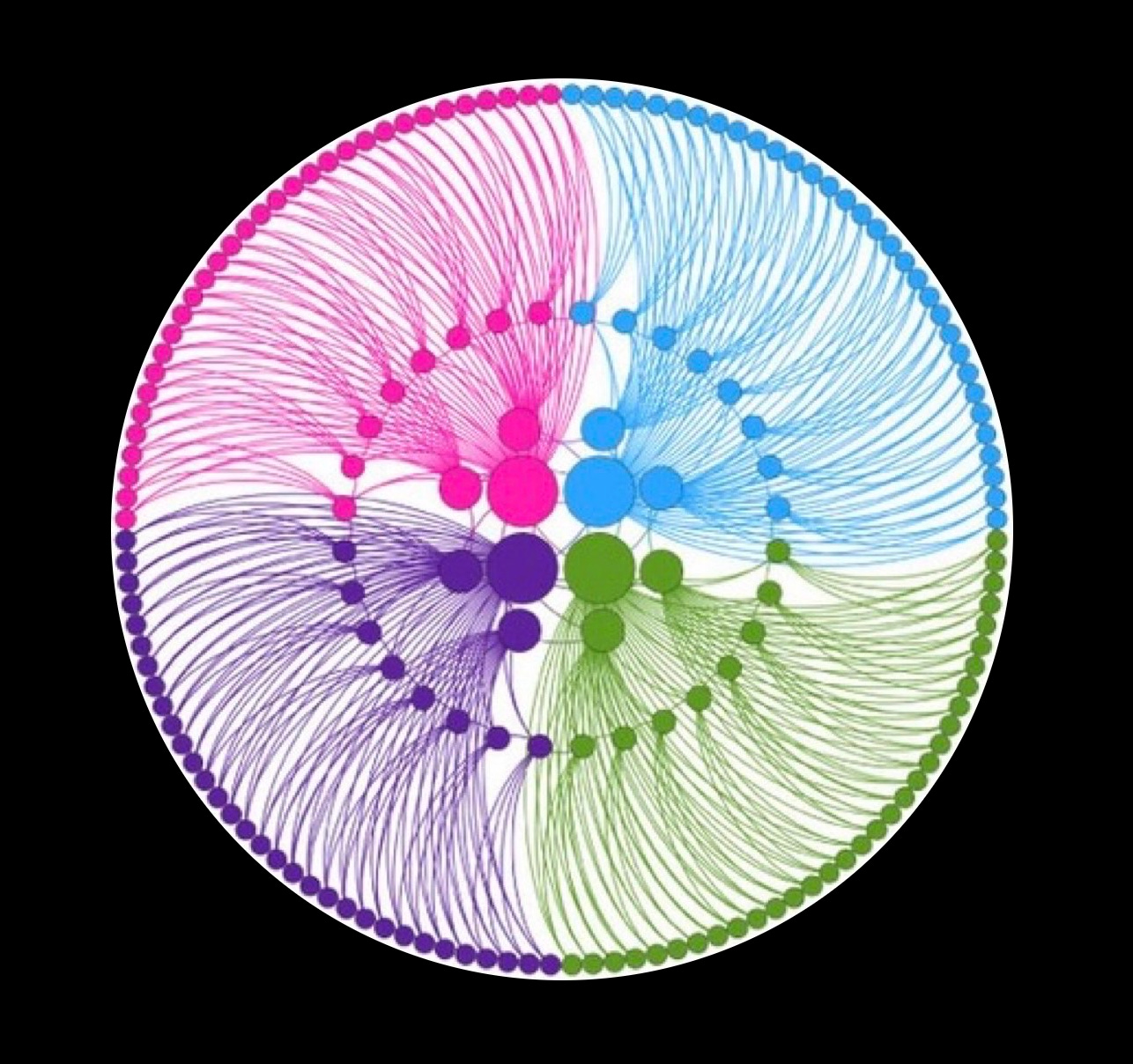
BitCoin, a peer to peer electronic cash system reads the title of the BitCoin white-paper, but what does the word peer mean exactly? In BitCoin’s early days, every participant in the network functioned as both a miner and a user. Users conducted transactions while simultaneously generating proof-of-work to secure the network. The software was a monolithic client, combining transaction functionality and network security. However, as BitCoin scaled, this unified model evolved into two distinct peer networks, each with specialized roles. Today, BitCoin operates as a fractal system of interconnected peers: a network of miners that maintains a complete ledger of all activity, and a network of users that only tracks transactions relevant to themselves. These two networks interact seamlessly in a topology that resembles a Mandala network, a structure where the core and periphery remain interdependent and harmonious.
The peer network of miners
Thanks for reading Crumbs's Substack! Subscribe for free to receive new posts and support my work.
The miner network forms BitCoin’s backbone, safeguarding its integrity and security. Miners validate transactions, group them into blocks, and add these blocks to the blockchain using proof-of-work. This process ensures not only that transactions are authentic but also that the network remains resistant to tampering and censorship.
Miners communicate directly with one another in a densely connected system known as a small-world network. This topology enables rapid propagation of transaction data, even across great distances. High-performance infrastructure powers this network, including specialized hardware known as Application-Specific Integrated Circuits (ASICs). ASICs are custom-built devices optimized for mining BitCoin, making them far more efficient than general-purpose computing hardware.
The competitive environment of mining drives continuous innovation. Miners are incentivized to build robust, low-latency connections to maximize their chances of successfully adding new blocks to the chain. This specialization ensures the network remains globally secure and capable of processing a high volume of transactions.
The peer network of users
The user network represents BitCoin’s practical side, where individuals and businesses initiate transactions, receive payments, and interact with blockchain-based applications. Unlike miners, users do not need to maintain a complete copy of the blockchain or perform proof-of-work. Instead, users focus on their own transactions, relying on wallets and simplified payment verification (SPV) to participate efficiently as as mentioned in the BitCoin white paper: “A user only needs to keep a copy of the block headers of the longest proof-of-work chain, which he can get by querying network nodes until he’s convinced he has the longest chain, and obtain the Merkle branch linking the transaction to the block it’s timestamped in.” [^1]
SPV is a feature mentioned in the BitCoin white paper, that allows users to verify transactions without running a full node, meaning they don’t have to download or store the entire history of BitCoin transactions. In some ways SPV works like redeeming a traveler’s cheque. The sender writes and signs the cheque, specifying the amount, and sends it directly to the receiver. The receiver then redeems the cheque through the banking system (or, in BitCoin’s case, the miner network) to ensure the funds are valid.
Satoshi Nakamoto anticipated this division of roles, writing:
“The current system where every user is a network node is not the intended configuration for large scale. That would be like every Usenet user runs their own NNTP server. The design supports letting users just be users.” [^2]
By only keeping a record of their own transactions, users minimise their storage and computational burden. They merely have to store or synchronise a few megabytes of data, including the block headers and Merkle trees of the transactions they are involved in. Businesses, however, may choose to maintain a more complete copy of the blockchain to track relevant transactions. They will only do this for scenarios where they are economically incentivised to do so, and can pass down the cost to store to their customers. Even so, they can prune older data that is no longer useful for their operations, to keep their costs at a minimum.
Miners and users as a mandala network
BitCoin’s architecture is fractal, with distinct yet interconnected layers that enable scalability and specialization. At its core, the miner network forms a dense, high-speed cluster responsible for transaction validation and global ledger maintenance. This core acts as the foundation for the entire system, ensuring that the blockchain remains secure and reliable.
Surrounding this core is the user network, a dynamic and lightweight layer of peers who are able and encouraged to interact directly with each other using’s BitCoin’s infrastructure using the principles described in section 8 of the bitcoin white paper (Simplified Payment Verification). These peers form the periphery of the network, benefiting from the secure backbone while maintaining the flexibility and simplicity of being able to send transactions directly from sender and receiver, where only the receiver has to verify whether an inbound transaction has not been double spent.
This fractal structure resembles a Mandala network: the dense, specialized core of miners provides connectivity to the broader, distributed periphery of users. This interplay ensures that BitCoin can support high volumes of transactions without causing network congestion.
## Growing the core and the edges
BitCoin’s evolution from a monolithic client in its early stages to a fractal network of several distinct types of peers that interact with each other, highlights its adaptability and long-term viability. Miners provide the infrastructure and security necessary for a robust blockchain, while users leverage this foundation to transact directly between each other, without requiring miners as transport for the transaction data.
This layered design ensures BitCoin’s scalability, enabling it to meet the needs of casual users and high-performance systems alike. With its Mandala-inspired structure, BitCoin achieves a balance of security, efficiency, and accessibility, solidifying its role as a revolutionary platform for payments and data.